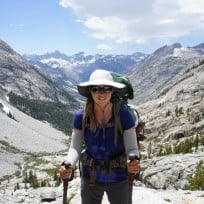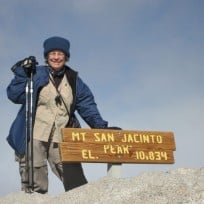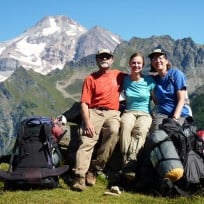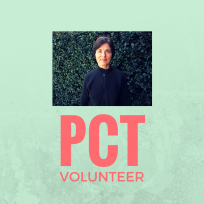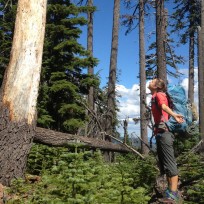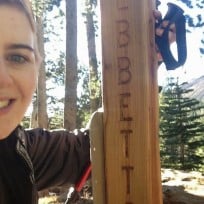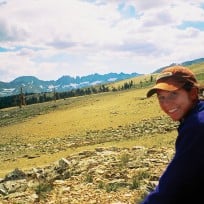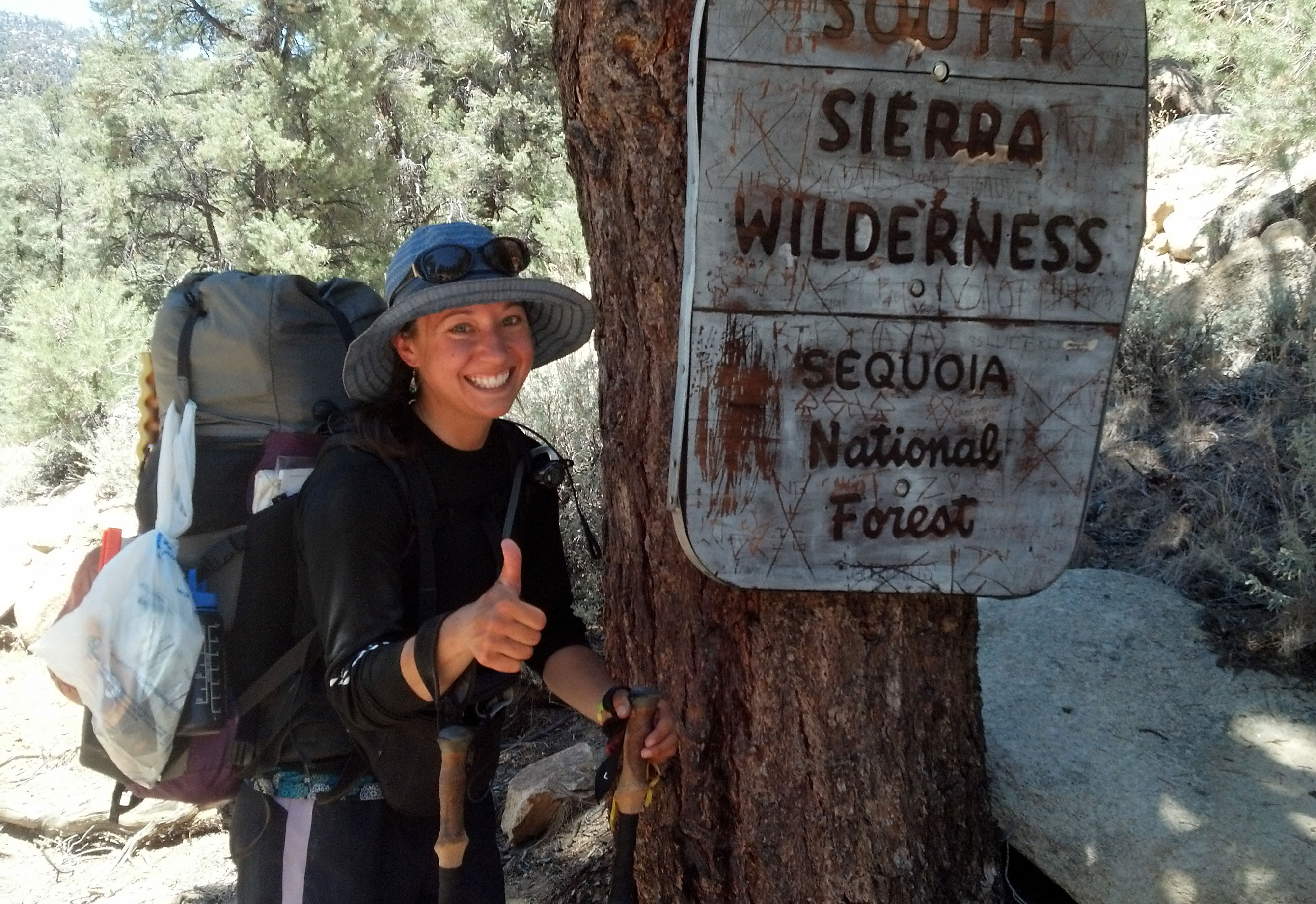
Dorothy “Bacon Bit” Brown-Kwaiser hiked the PCT in 2012 for the challenge and because, she says: “There is a wise, 80-year-old woman inside of me telling me that this – right here, right now – is my life. And it’s the only one I have. And I had better get the hell out there and do whatever it is that I think I want to do, because this is IT. I got tired of wanting to hike the Pacific Crest Trail and decided to listen to the wise old woman.” This is an essay she wrote for the Pacific Crest Trailside Reader blog after coming home from the PCT.
For nearly three years, walking has been my greatest obsession. Last spring, I tackled my first long trail – a thru-hike on the Pacific Crest Trail from Mexico to Canada.
From the day I resolved to attempt it in 2010 to my first steps away from the corrugated metal fence that is the Mexican border on April 30, 2012, I obsessed over the idea of walking – planning and preparing for a journey I could not comprehend from my temperature-controlled home in Silverton. For the next 151 days, I was immersed in the act of walking – traveling an average of 20 miles a day to reach Canada before the snows hit. And every day since those final steps on Sept. 28, my time and thoughts have been filled with reflecting on and recovering from walking.
Today, I look out the windows of the Tryon Creek Nature Center where I have just started working as an Interpretive Park Ranger, and I see countless people walking. All hours of the day, all days of the week.

And so, it is in this light that I would like to write about walking.
Let me begin with a few of the lessons I learned during my six-million-step journey:
- A good long walk takes the weight of years and worries off your shoulders. You’ll lose as many pounds of actual weight as you do of worry.
- Nothing is so worrisome that you can bear to worry about it for 14 waking/walking hours a day, 7 days a week.
- Rest is as important as anything else in the world, as are water and nourishment. Without these three, nothing is important.
- All food tastes better after a long day’s walk.
- Anywhere really IS within walking distance if you have the time.
- “Walk it off” is more than just a coaching cliché. Many ailments, physical and mental, can be cured by a nice long walk.
- Walking is for everyone. The tall and the small, the young and the old, the injured and the well, the elk, the porcupine, and the goat. I found them all traveling the PCT.
- If you walk far enough, you will find answers. You may not find all of them. But you will find answers you were not looking for and questions you did not know you had. Rest easy knowing that your question to answer ratio will remain the same.
- You cannot walk away from your problems, only into them.
- Clarity rides on the shirttails of fresh air.
- Christopher Robin was right when he said, “… we ought to eat all of our provisions now, so that we shan’t have so much to carry.”
And last, but not least, for all those of us who have neither the time nor energy for an expedition-length walk:
- A long walk is nothing more than a series of short ones.
The above is what I learned while walking the PCT. My most valuable lesson, however, came post-trail.

Since finishing the PCT, I have had a limited ability to walk. In northern California, I developed plantar fasciitis. One thousand miles later, upon finishing the trail, I found I could walk no more than 100 yards – and at a snail’s pace – as I attempted to balance pain with distance and pretend that everything was fine. When I awoke at night with no one watching, I would crawl to the bathroom rather than put weight on my feet. This drastic transition from hiking 25 miles a day to hobbling to the kitchen has been one of the most humbling experiences of my life. My appreciation for the simple act of putting one foot in front of the other has increased tenfold. As has my awe and respect for all of you walkers – tall and small, young and old, injured and well – who make the time and effort to do it.
It has only been through reflecting on and recovering from the PCT that I have fully grasped the final lesson of a long walk, which is this: Sometimes putting one foot in front of the other is the most difficult thing you can do. It is sometimes also the only thing you can do.

Thanks to the editors of www.PCTTrailsideReader.com and to Dorothy “Bacon Bit” for sharing this essay with us. Dorothy works as a Park Ranger for Oregon State Parks in the Columbia River Gorge –19 miles from the PCT at Cascade Locks. To read more about Dorothy’s PCT adventure, visit dorothyspctblog.blogspot.com.