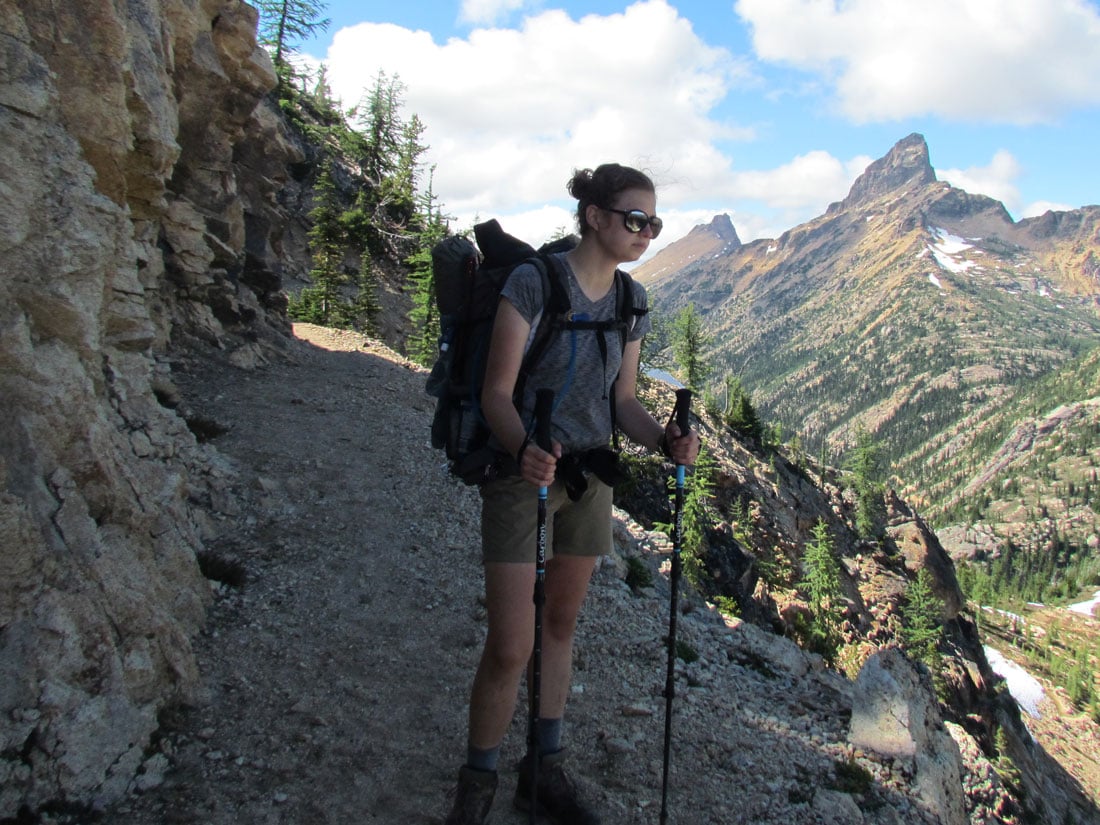
Perspective is a beautiful thing. It allows you to understand yourself, others and the environment, essential to living in our complex society. But how does one gain this oh-so-necessary element of existence? I suppose you could spend years in therapy analyzing yourself and your surroundings. You could lock yourself in the philosophy section of a library and not leave until you know the meaning of life.
Or, as I found out, you could just take a walk in the woods.
In July, I was fortunate enough to have the opportunity to take such a walk. The Pacific Crest Trail Association’s Board of Directors was having its quarterly board meeting in Manning Provincial Park, at the trail’s northern terminus. Several board members decided that instead of taking a more predictable method of transportation to the meeting, they would rather walk.
And thus, “The Boardwalk” was born: a ragtag group from across the nation comprised of thru-hikers, section-hikers, and hikers-by-hobby assembled to take 15 days to hike the 200-mile stretch from Stevens Pass, Washington, to the Canadian border.
Last January, my father, Rick Thalhammer, attended his final board meeting after some nine years of service, and though he has termed out from being a full-fledged board member, he still plays an active role in volunteering for the trail. He was invited on the hike, and by association so was I.
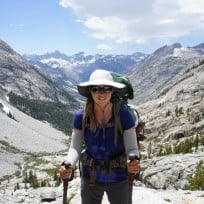
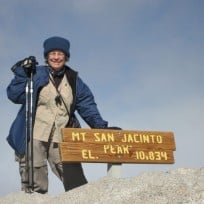
I am not an experienced backpacker. In fact, until this year I could have counted all my one- and two-night trips on one hand. Once we decided to go on this hike, though, my father and I began a six-month training program that included day hikes of increasing difficulty and overnight and two-night backpacks. Our training plan culminated in a five-day trip covering close to 60 miles in the High Sierra.
Over the course of these trips, I began to gain a new appreciation for hiking. It was no longer just a means to a destination as I had seen it in my childhood. I felt my eyes opening wider, my curiosity growing stronger and my sense of awe increasing exponentially with each wilderness foray.
I wondered what things looked like from a beetle’s point of view. I pondered what quail thought about as they scuttled from bush to bush. Why would people ever congregate in cities when they could get out and enjoy the forest?
As the hike drew closer, my excitement heightened with the anticipation of two relatively uninterrupted weeks of immersion in the pristine natural world.
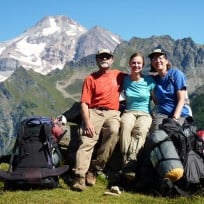
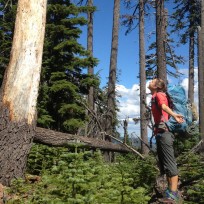
Eleven of us met at the Stevens Pass trailhead. I couldn’t wait to finish the pre-hike pictures and announcements and actually put my boots to the ground. We were still within earshot of the freeway and I desperately wanted to escape into desolation. Once we got going and settled out into our individual trekking paces, I noticed that my gait put me ahead of the bulk of the group. I wondered if I should make an effort to stay with them, but I soon decided that we couldn’t all hike at the same speed the whole trip and I allowed myself to enjoy the solitude. Soon, I was in a rhythm. My breathing set the beat for my steps to follow. I watched the evergreens rush past in my peripheral vision as I focused on where to plant my feet. Before long, I was placing my steps subconsciously, which allowed my mind to travel elsewhere.

While hiking is the most meditative pastime in which I regularly participate, the amount of time I get to spend on the trail is relatively small. I often find myself trying to force my mind into profound thought patterns while on the trail; I feel as though I should maximize my alone time by immediately jumping to the heaviest subjects, such as mapping out my life’s path, or attempting to answer some of philosophy’s greatest questions, e.g. what is the point of life?
But in reality, this is the epitome of what I wish to avoid. The best way to answer those questions, I’ve found, is to allow the answers to reveal themselves naturally. Instead of trying to force certain mental agendas, why not let my thoughts be dictated by my environment? So I attempted to keep my mind clear of unanswerable queries and impossible puzzles, and instead returned to thinking about how it must feel to have six legs and be a quarter inch tall. In what seemed like only moments, I was reunited with the group and setting up camp, and I was grounded again from my imaginings of alternate viewpoints.

The next day, we were confronted with what turned out to be the first of many hindrances to our hike. It began with the trail being covered in snow, and the group decided, based on our skill level and the schedule we had to keep, that it was impossible to continue. Next, we scrambled to find an alternate route and arranged a ride to get there.
Our first day back on the trail after a respite at the Stehekin Resort on Lake Chelan, brought rain and, for me, a stomach bug. The second day delivered air clogged with smoke from a nearby forest fire and concerns that the trail angel friends bearing our resupply wouldn’t be able to reach us because the roads might be closed. And the weather forecast was troubling as well.

We did get our resupply, though the day brought the rain and cold that had worried us the night before. The temperature in Stehekin had been over 100 degrees, prompting several group members to mail home their warm layers to shave weight from their packs. I had been one of those people and the news of rain and potential snow for the duration of the trip gave us serious pause as we considered the very real possibility of hypothermia. Although it was about the last thing any of us wanted to do, seven of us got off the trail at Hart’s Pass. I fought tears and frustration during a six-hour drive to Seattle.
The hardest thing for me to do while facing these setbacks was to keep perspective. While that was what I practiced during the hike, the moment a problem appeared, I seemed to only focus on the negative feelings it produced and the apprehension of struggles to be faced. During these times of stress and anxiety, I felt as though everything was falling apart. As it ended, however, those of us who stepped off the trail at Hart’s Pass walked just over one hundred miles instead of two hundred, and spent about 11 days hiking rather than 14. In the grand scheme of it all, then, while I had to let go of my original goal, I was still able to accomplish a major trek. And I consider myself lucky for that. With each challenge I noticed myself becoming increasingly stable, increasingly rational; and now that I am looking back, I believe I learned how to deal with trials more effectively and directly, precisely because of what that trip handed me.

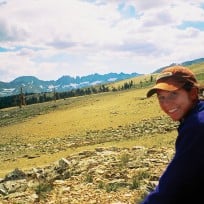
I try to be mindful of everything around me when I hike, from the wildlife to my emotions, from the geology to my bodily sensations. There are few things I enjoy as much as the slow and physical nature of backpacking and I treasure the unique chance to put myself in the place of countless organisms. From everything I encountered on this excursion of never ending surprises, I learned to not only attempt to gain new perspectives, but to be sure I maintain my own.